
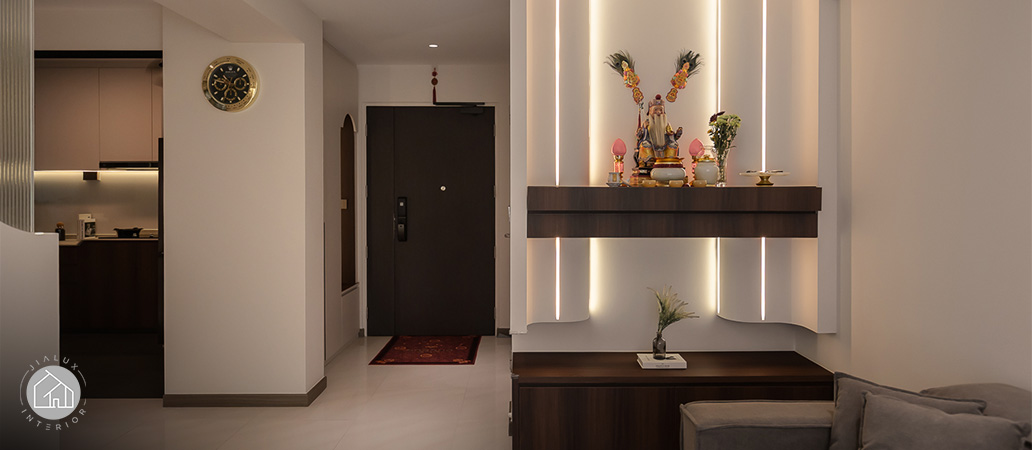
Introduction
Durable interior design is often reduced to the idea of physical longevity. In reality, what truly endures in a home is whether the space continues to support daily life with ease, clarity, and relevance over the years. Surfaces may hold up, but if the layout, storage logic, or material choices no longer serve the household, the design has not fulfilled its deeper purpose.
In Singapore, renovation is rarely a light refresh. It is a significant financial and emotional investment, especially for BTO owners, resale homeowners, and families upgrading to larger properties. These are long-term commitments rather than temporary interventions. Early decisions shape daily routines, storage behaviour, maintenance effort, and comfort levels long after the initial excitement fades. Rectifying misjudged layouts or replacing built-in carpentry several years later is not simply inconvenient. It is financially disruptive and emotionally draining.
Many homes begin with strong visual coherence. Lighting is flattering, finishes feel new, and the space photographs well. Yet as years pass, subtle misalignments emerge. Storage may prove insufficient. Circulation may feel tighter than expected. Materials that once looked impressive may require more upkeep than anticipated. In compact Singapore layouts, even small miscalculations in walkway clearance or cabinet depth can compound into daily frustration. As routines evolve and families grow, the home can begin to feel less aligned with lived realities.
Durability in this context refers to decision resilience. It is the ability for design choices to remain sensible, comfortable, and emotionally appropriate as life circumstances shift. This goes beyond hardware quality or carpentry thickness. It reflects foresight in planning, proportion, material selection, and spatial hierarchy. It also requires anticipating maintenance cycles and wear patterns shaped by Singapore’s humidity and everyday living conditions.
In refined homes, durability is rarely overt. It is recognised through the absence of friction rather than the presence of spectacle. Doors close quietly. Storage feels intuitive. Finishes age gracefully. The environment supports focus and rest without demanding constant adjustment.
This article examines how interior design decisions can remain grounded and supportive over time. Rather than prioritising short-term trends or surface appeal, it focuses on the thinking that underpins lasting assurance in the home. When durable interior design is approached as disciplined judgment instead of visual novelty, design intent and execution remain consistently aligned with how the space is used every day.
Key Takeaways
- Homes that remain satisfying over time are shaped by early clarity of intent, realistic lifestyle planning, and disciplined decision-making rather than short-term visual appeal.
- The true measure of good design emerges through everyday use, where circulation, storage, lighting, and material practicality determine long-term comfort.
- Consistency across all spaces helps interiors mature evenly, preventing fragmentation and preserving a calm, cohesive environment.
- End-to-end accountability and thoughtful execution reduce regret, allowing homeowners to commit to their decisions with lasting assurance
What Allows Interior Design Decisions to Hold Their Relevance Over Time
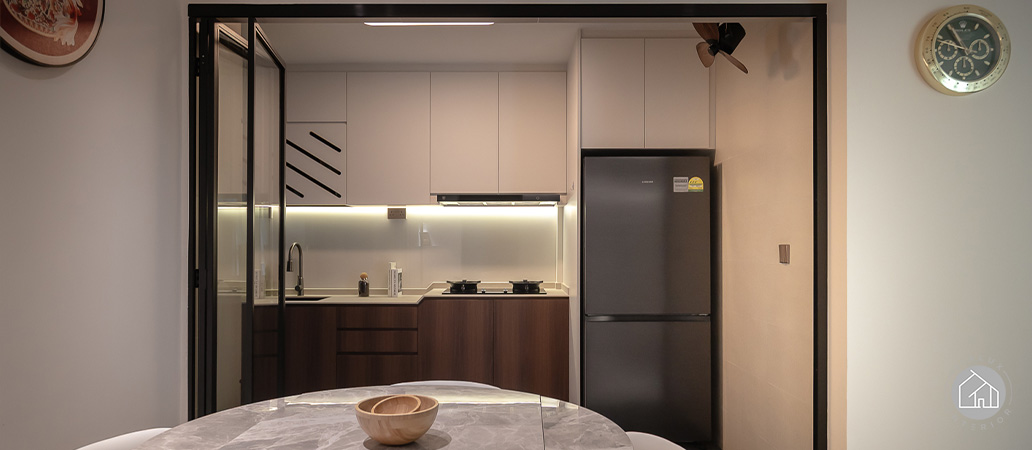
Durability as Design Foresight Rather Than Visual Permanence
Why Durability Is Often Misunderstood at the Start of a Renovation
Many homeowners equate durability with neutral palettes or restrained styling, assuming that minimising expression automatically guarantees longevity. Yet durable interior design is not achieved simply by choosing beige walls or muted finishes. Longevity is shaped more by planning logic, spatial flow, and material suitability than by colour restraint alone.
This assumption overlooks how homes are actually experienced. Daily use, maintenance effort, lighting conditions, and emotional comfort influence satisfaction far more than visual neutrality. A space can appear understated at handover yet still create friction if circulation is tight or storage proves insufficient. For example, installing a kitchen island in a compact BTO may look impressive during design discussions, but it can reduce functional walkway clearance. True design durability considers how spaces function under repeated, ordinary use.
Interiors that appear timeless at completion can still feel restrictive years later if early decisions were framed around a narrow snapshot of life. A young couple may design purely for two, only to realise that evolving routines require different spatial priorities. In this sense, durable interior design is grounded in thoughtful foresight, where choices remain appropriate even as context shifts.
Rather than focusing on what looks safe at the outset, foresight asks how a decision will be lived with over extended periods. In projects such as HDB resale interior design, this foresight is particularly important because layouts often require substantial reconfiguration. Relocating walls, plumbing points, or structural elements should address current needs without restricting future flexibility. When durability is approached as disciplined thinking instead of stylistic caution, the result supports sustained suitability rather than temporary agreement.
Decisions That Continue to Make Sense Beyond Their Original Context
Interior decisions endure when they are not overly dependent on a specific life phase or routine. Built-in storage designed with adaptability in mind, for example, can serve different needs over time without requiring reconstruction. Adjustable shelving systems, concealed storage rather than open display, and balanced wardrobe allocations reduce the risk of premature redesign.
Homes that age well allow reinterpretation without losing coherence. A study may later function as a nursery. A guest room may become a workspace. These transitions feel natural when proportions, lighting, and circulation are thoughtfully resolved from the beginning. Durable interior design supports multiple ways of living while maintaining clarity.
Rather than dictating behaviour, resilient interiors accommodate different rhythms of life. This principle is equally relevant in residential interior design projects in Singapore across property types. Whether it’s a compact BTO unit or a larger private home, lasting durability comes from early alignment between real lifestyle needs and thoughtful spatial planning.
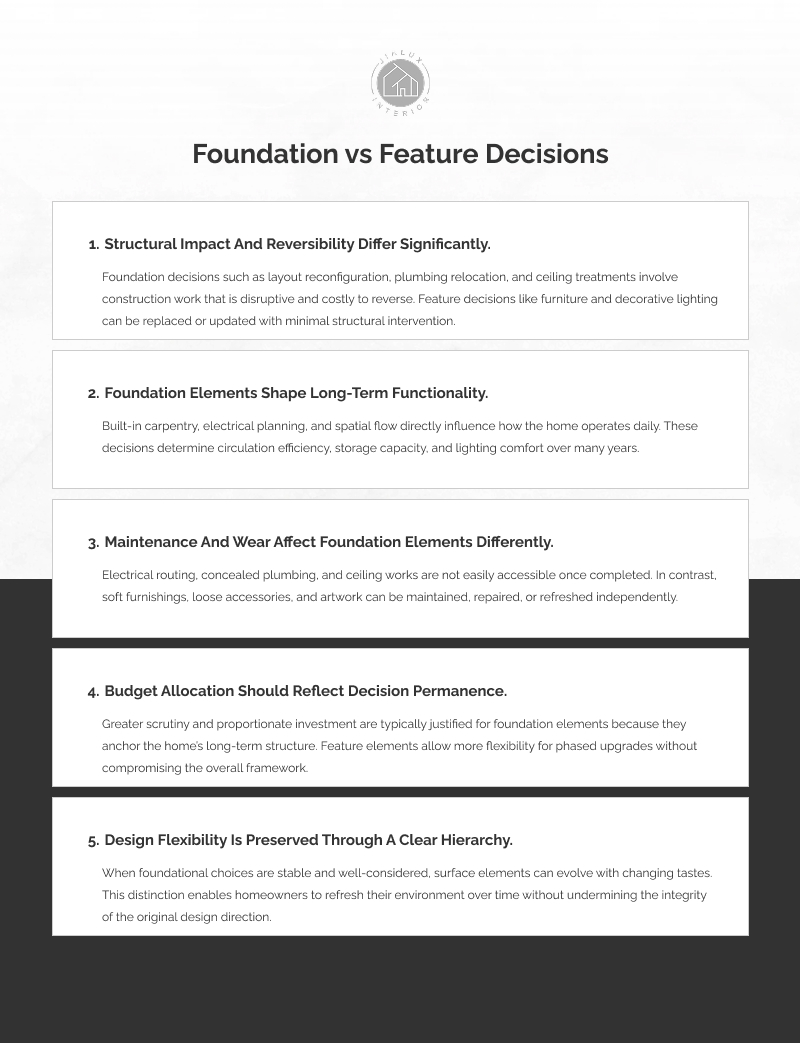
This adaptability is not accidental. It reflects foresight applied during early design conversations, where future suitability is weighed alongside immediate preferences. A useful test is whether the design element serves a foundational function or merely delivers a momentary visual statement. When homeowners plan how their home will be used over time, rather than focusing on short-term excitement, they create a foundation for durable interior design that remains stable as their priorities evolve.
Design Judgment as the Quiet Foundation of Durability
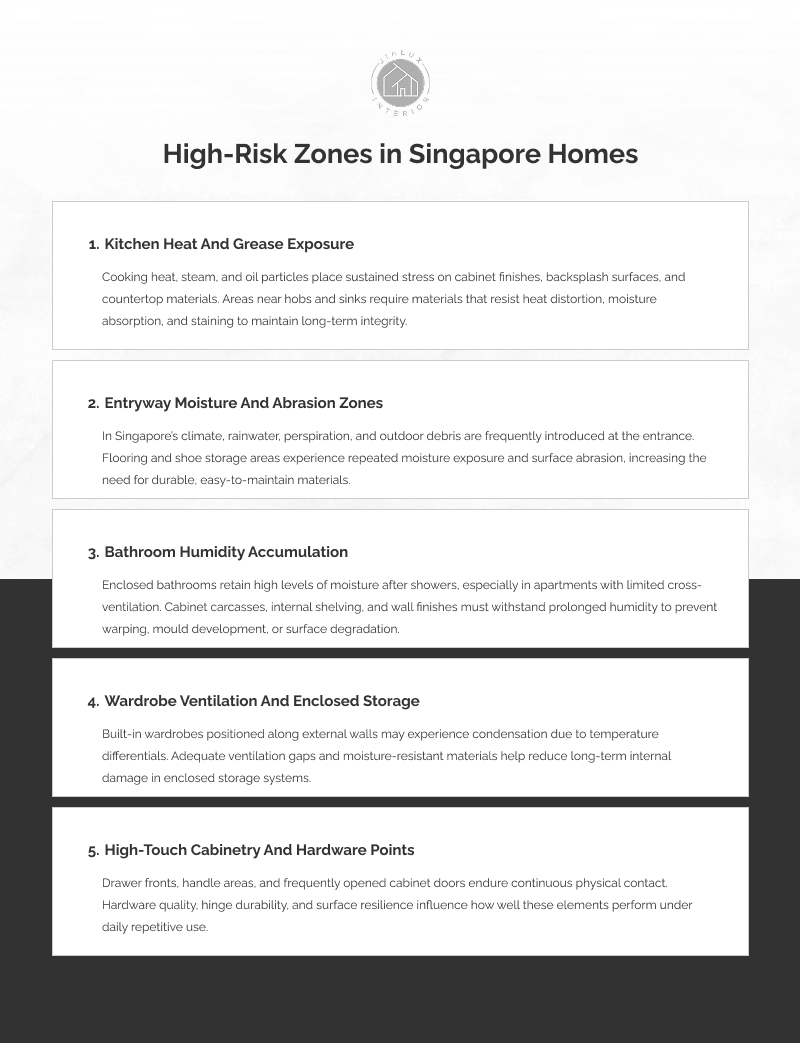
The durability of an interior ultimately reflects the quality of judgment exercised at the point of decision. Materials are selected not only for appearance but also for wear patterns, maintenance cycles, and tactile comfort. High-traffic zones require finishes that resist moisture, staining, and heat rather than materials chosen solely for aesthetic impact. Layouts are evaluated for movement efficiency rather than aesthetic symmetry alone.
Decisions shaped by clarity and restraint tend to require less correction over time. In thoughtfully executed homes, visual calm is supported by structural logic. This is especially evident in luxury interior design projects in Singapore, where composure, proportion, and detailing contribute to long-term coherence rather than short-lived impact.
In refined residences, durability is expressed quietly. The design continues to feel resolved rather than increasingly questioned. Durable interior design in this sense is less about permanence and more about sustained appropriateness, where choices continue to feel measured and intentional years after completion.
How Everyday Living Gradually Reveals the Strength of Design Decisions
The Gap Between Imagined Use and Real Daily Experience
At the design stage, homeowners often imagine ideal routines. Kitchens appear organised, wardrobes appear sufficient, and living areas feel generous. However, daily repetition quickly reveals whether those assumptions were realistic. The true strength of durable interior design becomes visible through everyday practicality rather than occasional hosting.
Over time, convenience becomes more important than novelty. If drawers are positioned awkwardly or finishes require excessive care, minor inconveniences accumulate into dissatisfaction. Durable interiors anticipate these small frictions and reduce them before they become habitual frustrations.
The true test of a design decision emerges not during celebrations or social gatherings but in ordinary weekday mornings and late evenings. In luxury condo interior design, where expectations of comfort run high, everyday usability is often what separates lasting satisfaction from early disappointment.
Durable interiors accommodate routine without demanding constant adjustment. When lighting levels, storage access, and material choices align with lived patterns, the space feels supportive rather than demanding. This alignment is a core principle of durable interior design.
Emotional Alignment as a Long-Term Design Consideration
Beyond function, homes must remain emotionally appropriate. Interiors that age poorly often do so because they no longer reflect how homeowners see themselves. Tastes mature, priorities shift, and the desire for calm frequently increases with age.
Durable interior design acknowledges that emotional alignment evolves. Instead of relying on bold gestures that define a specific moment, it favours composure and proportion. This approach supports a stable and unified environment, allowing the home to remain relevant without feeling outdated.
As novelty fades, emotional comfort becomes a more reliable measure of success than initial impact. A home that feels steady and grounding contributes to a stronger sense of attachment over time. This consideration becomes especially important in landed house interior design projects in Singapore, where properties are often intended for multi-generational living or extended ownership horizons. Because structural alterations in such homes can be complex and disruptive, emotional misalignment is less easily corrected through frequent renovation. A design direction that remains appropriate across different life stages therefore carries greater practical and psychological weight.
When emotional alignment is considered from the outset, homeowners experience less tension between who they were at completion and who they become in the years that follow. This continuity reinforces the value of durable interior design as a long-term framework rather than a stylistic phase.
Interior Design That Matures Alongside Its Owners
Homes that endure tend to settle into quiet assurance. As familiarity grows, clarity and calm become more valuable than constant stimulation. Finishes develop patina, layouts feel intuitive, and the space becomes integrated into daily identity.
Durable interiors allow homeowners to grow into the environment without repeatedly justifying earlier choices. This maturity strengthens attachment because the space continues to feel supportive rather than dated. Such outcomes are rarely accidental. They reflect the deliberate application of durable interior design principles during early planning.
Why Some Design Decisions Age Gracefully While Others Become Points of Friction
Impact-Driven Choices Versus Continuity-Driven Decisions
Decisions made primarily for immediate visual impact often prioritise novelty. While visually striking at first, these elements can feel disconnected from everyday needs over time. When impact outweighs practicality, friction gradually emerges.
Continuity-driven decisions, by contrast, support sustained comfort. They are grounded in proportion, material integrity, and thoughtful detailing. Durable interior design favours this continuity by prioritising lived experience over momentary differentiation.
When relevance is maintained through consistency rather than emphasis, interiors feel stable. This stability allows homeowners to trust their choices long after trends shift.
Allowing Change Without Undermining Cohesion
Design decisions that are too rigid can limit adaptability. Conversely, choices without structure can create visual uncertainty. Durable interiors balance flexibility within a clearly defined framework. This structure supports change while preserving identity.
When this balance is achieved, homes evolve without feeling fragmented. The framework remains intact even as furniture, accessories, or personal priorities shift. This stability reinforces the value of durable interior design as an approach grounded in foresight rather than fixed prediction.
Living With Commitment: Why Durable Design Requires Confidence
Committing to long-term decisions can feel uncomfortable because life circumstances are unpredictable. However, durable interior design does not attempt to forecast every future scenario. Instead, it provides confidence that core decisions will remain appropriate across different phases.
This confidence arises from clarity of intent. When homeowners understand why materials were chosen, why walls were repositioned, and how storage was calculated, they are less likely to second-guess those choices. In high-investment projects, including refined luxury homes, this clarity supports sustained assurance rather than ongoing doubt.
Regret as an Indicator of Misaligned Priorities
Design regret often arises when earlier choices are guided by fleeting preferences rather than enduring relevance. Poorly considered layouts, insufficient storage, or high-maintenance materials gradually undermine satisfaction.
Durable interior design reduces regret by grounding decisions in a realistic assessment of daily living patterns. The objective is not perfection at completion but stability years later. When design decisions prioritise everyday practicality over short-term visual appeal, homeowners are more likely to feel assured rather than reconsidering fundamental choices.
Durable Interior Design in Practice
How a Clear Design Direction Builds Long-Term Confidence
Establishing Alignment Before Commitment
Jialux Interior places strong emphasis on defining design intent at the earliest stage of discussion. Before materials are selected or layouts confirmed, conversations centre on how homeowners genuinely live, how they use their evenings, how they host, and how storage is realistically required. This clarity reduces the risk of designing around assumptions that may not hold up in daily life.
When intent is clearly articulated, commitment becomes steadier. Homeowners are less likely to question foundational decisions later because those choices were grounded in honest lifestyle evaluation rather than visual impulse. In this way, lasting design quality begins not with finishes but with alignment.
A well-defined direction also reduces hesitation during the renovation process. When every decision links back to a coherent framework, revisions are purposeful rather than reactive. Over time, this clarity protects the home from drifting away from its original rationale.
Maintaining Consistency Across the Entire Home
Design decisions are evaluated in relation to the entire environment rather than treated as isolated upgrades. Jialux Interior reviews spatial flow, material transitions, lighting temperatures, and storage logic as part of a connected whole. This prevents situations where different rooms feel disconnected in tone or quality.
Consistency is particularly important in projects that involve significant reconfiguration, such as older resale flats. Without a holistic approach, certain zones may feel resolved while others feel secondary. Lasting design quality depends on maintaining cohesion across all spaces so that the home matures evenly rather than in fragments.
When transitions between living, dining, and private areas are carefully managed, the environment continues to feel unified years later. By preserving a composed identity, this cohesion strengthens long-term satisfaction and prevents the home from becoming visually or functionally disjointed.
Design Discipline as the Basis of Long-Term Relevance
Durable interior design requires the discipline to prioritise coherence over excess. In practice, this means assessing whether a feature contributes meaningfully to the overall environment or merely provides short-lived visual impact. Jialux Interior approaches each project with measured restraint, ensuring that aesthetic choices are supported by proportion, practicality, and material integrity.
Material specification accounts for humidity exposure, cleaning frequency, and impact resistance in high-traffic zones. Cabinet hardware is selected for durability under repeated handling. Lighting plans are calibrated to avoid glare while maintaining warmth. These considerations reduce future dissatisfaction without compromising refinement.
Rather than reacting to fleeting preferences, decisions are assessed for their long-term implications. Finishes are selected with consideration for wear patterns and maintenance requirements. Carpentry layouts are reviewed for usability across different life stages. This structured thinking reinforces a long-term framework rather than a short-term statement.
The result is a composed interior that supports quiet luxury without overwhelming the occupants. Calmness is achieved through balance and proportion rather than ornamentation. Over time, this discipline keeps the home relevant because it was never dependent on novelty in the first place.
End-to-End Accountability and Its Influence on Design Durability
When Intent and Outcome Gradually Drift Apart
Even small inconsistencies between design intent and execution can weaken a home’s sense of resolution. Misaligned finishes, compromised detailing, or uncoordinated adjustments may not be obvious at completion but can become more noticeable over time in daily use.
These gaps often surface gradually. A cabinet edge that chips prematurely or a lighting plan that feels uneven can subtly alter how the space is experienced. When intent and outcome diverge, confidence in the overall environment may erode over time.
Accountability as Long-Term Assurance
Jialux Interior maintains end-to-end oversight from conceptual planning through site coordination. This continuity ensures that what was agreed during early alignment discussions is carried through during execution. Details are not treated as secondary but as integral to preserving the integrity of the overall concept.
By overseeing both design translation and implementation, the firm reduces the likelihood of compromise between drawing and reality. This consistency strengthens long-term durability because decisions are not diluted during handover or construction stages.
For homeowners, this accountability provides reassurance. The environment they committed to is executed with care, and the coherence established at the beginning remains intact as the years progress.
Questions You Might Ask
1. How does Jialux Interior approach durability beyond the point of renovation completion?
Durability is considered from the perspective of how a home continues to function, feel, and remain relevant long after the renovation is complete. Rather than focusing only on the moment of handover, design decisions are evaluated for how they will support daily life over time. This includes considering how spaces are likely to be used repeatedly, how expectations may evolve, and whether the overall design intent remains appropriate as lifestyles mature. The aim is for the home to feel settled and coherent years later, not just resolved at completion.
2. What gives homeowners confidence that early design decisions will continue to feel right?
Confidence comes from clarity at the outset. When design intent is clearly defined and aligned with how homeowners genuinely live, decisions feel grounded rather than speculative. This clarity reduces the need for constant justification or rethinking later on. Instead of relying on novelty or short-term appeal, the focus is on making decisions that homeowners can remain comfortable with as familiarity replaces first impressions.
3. How does Jialux Interior balance personal expression with long-term clarity?
Personal expression is approached through thoughtful interpretation rather than literal translation. Individual preferences are carefully understood and integrated in ways that do not overly anchor the home to a specific phase or impulse. By maintaining a clear overarching direction, the design allows homeowners to see themselves reflected in the space while ensuring that the home remains coherent and relevant as tastes and priorities naturally evolve.
4. Why does a structured design direction matter for lasting satisfaction?
A structured design direction provides a stable framework within which individual decisions make sense together. Without this structure, interiors can feel fragmented over time, even if each decision feels right in isolation. When direction is clearly established early on, it becomes easier for the home to age evenly, maintaining a sense of resolution rather than gradually feeling pieced together or uncertain.
5. How does Jialux Interior support homeowners who value refinement without chasing trends?
Refinement is treated as a quality that emerges from restraint, coherence, and considered judgment rather than from following what is current. By prioritising clarity and composure, the design avoids relying on trends to create impact. This allows homeowners to enjoy a space that feels quietly confident and appropriate over the long term, without the pressure to update or re-interpret their home constantly as design preferences shift.
Conclusion
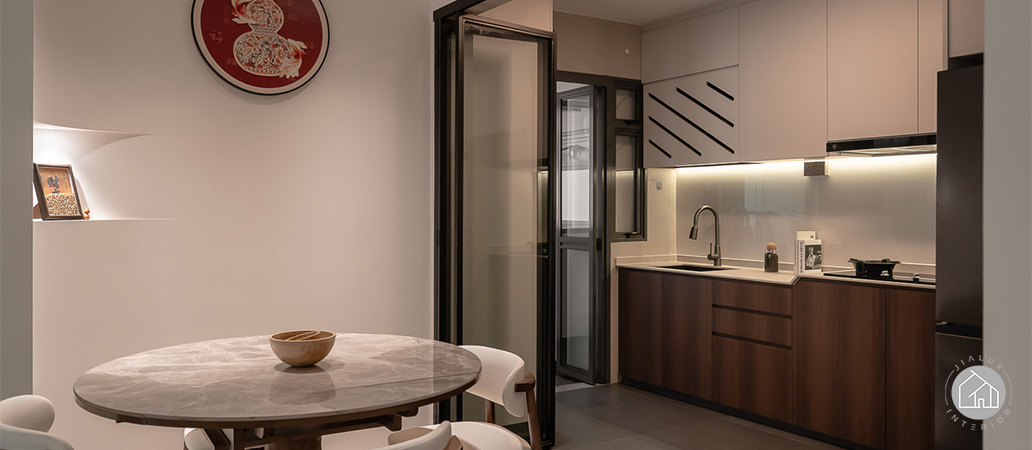
Durable interior design is not about resisting the passage of time. It is about accommodating it with clarity and foresight. Homes that remain appropriate over the years do so because their foundational decisions were shaped by proportion, realism, and disciplined thinking rather than immediate impression.
In refined living environments, durability is reflected in calmness, consistency, and ease of use. Materials age with dignity. Layouts remain intuitive. The overall composition feels resolved rather than frequently reconsidered. This is the essence of durable interior design, where clarity replaces reactive updating.
Jialux Interior works with homeowners who value lasting assurance over momentary excitement. By translating complex lifestyle needs into a coherent and structured design direction, the firm provides a stable framework for confident decision-making.
For homeowners planning a long-term move or meaningful upgrade, a consultation with Jialux Interior offers the opportunity to evaluate decisions through a ten-year lens, align design with real patterns of living, and establish a direction that continues to make sense well beyond completion.