

Privacy as a Core Design Requirement in Singapore Homes
In Singapore’s high-density living environment, designing for privacy has shifted from a secondary concern to a critical design necessity that influences daily life. With residential developments being built closer together and internal layouts becoming more open, privacy is no longer guaranteed and must be intentionally incorporated into the home’s design.
Here, privacy goes beyond the simple act of closing a door. It influences how residents navigate their homes, how personal routines unfold, and how much control they have over visibility and interactions within shared spaces.
Many homeowners only realise the importance of privacy after moving in, when daily activities such as working, resting, entertaining, or simply transitioning between rooms begin to feel disrupted by the openness of the interior layout.
This article presents privacy as more than just an emotional need or aesthetic choice. Instead, it is seen as a design result that relies on careful planning, clear spatial hierarchy, and precise execution from the outset of the renovation process. Designing for privacy should be integrated early in the design process to meet the practical needs of daily living.
Key Takeaways
- Achieving privacy in high-density living requires careful consideration of internal and external factors, like the proximity of neighbouring buildings and open-plan layouts.
- Instead, it is regarded as a design outcome that depends on careful planning, clear spatial hierarchy, and precise execution from the start of the renovation process.
- Clear spatial zoning, such as using transitional spaces and defined boundaries, is essential for maintaining privacy in homes with open layouts.
- Selecting high-quality materials and applying precise craftsmanship are crucial for preserving privacy and ensuring that both aesthetic appeal and practical functionality are sustained over the long term.
Understanding Privacy in High-Density Living
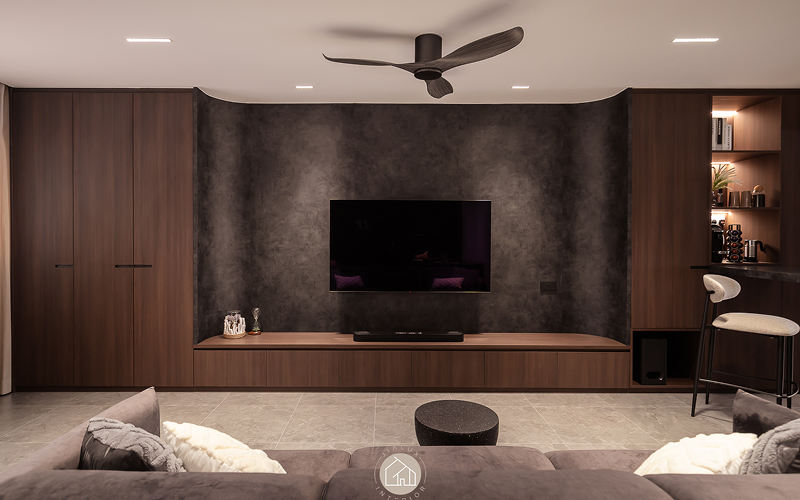
Why Privacy Is Increasingly Difficult to Achieve in Contemporary Singapore Homes
Urban Density and Architectural Proximity
In Singapore, modern residential developments often feature reduced physical distance between blocks, leading to closer window-to-window relationships and overlapping sightlines. Even on higher storeys, neighbouring units often remain within direct line of sight. This creates challenges when designing for privacy. Shared architectural features, such as corridors, lift lobbies, and opposing balconies, introduce additional layers of exposure that cannot be adequately addressed through interior furnishings alone. As developments increasingly prioritise maximising land-use efficiency, privacy challenges are arising more frequently from external factors, which interior design must address rather than ignore.
Interior Layout Trends That Reduce Personal Separation
In contemporary homes, designing for privacy is crucial, as the trend toward open layouts, where living, dining, and kitchen areas flow along uninterrupted sightlines, reduces opportunities for natural separation between activities. While visually appealing, this layout compromises the ability to create distinct work, rest, and recreation spaces. Entrances that open directly into living spaces remove transitional buffers, immediately exposing private household activities upon arrival. Bedrooms, work areas, and shared zones that are positioned too closely together increase the likelihood of visual and behavioural overlap, particularly in multi-occupant households. For homes with limited square footage, these design choices can make achieving adequate residential privacy design even more challenging.
The Reality Gap Between Showflat Design and Daily Living
Showflat layouts are designed to impress with spaciousness and visual flow, but they often fail to reflect the practical challenges of daily life. Privacy issues often emerge once routines stabilise and residents begin working from home, hosting guests, or sharing spaces on different schedules. These issues can be difficult to resolve without structural changes, highlighting the importance of designing for privacy early in the design phase, rather than after completion.
Redefining Privacy Beyond Physical Barriers
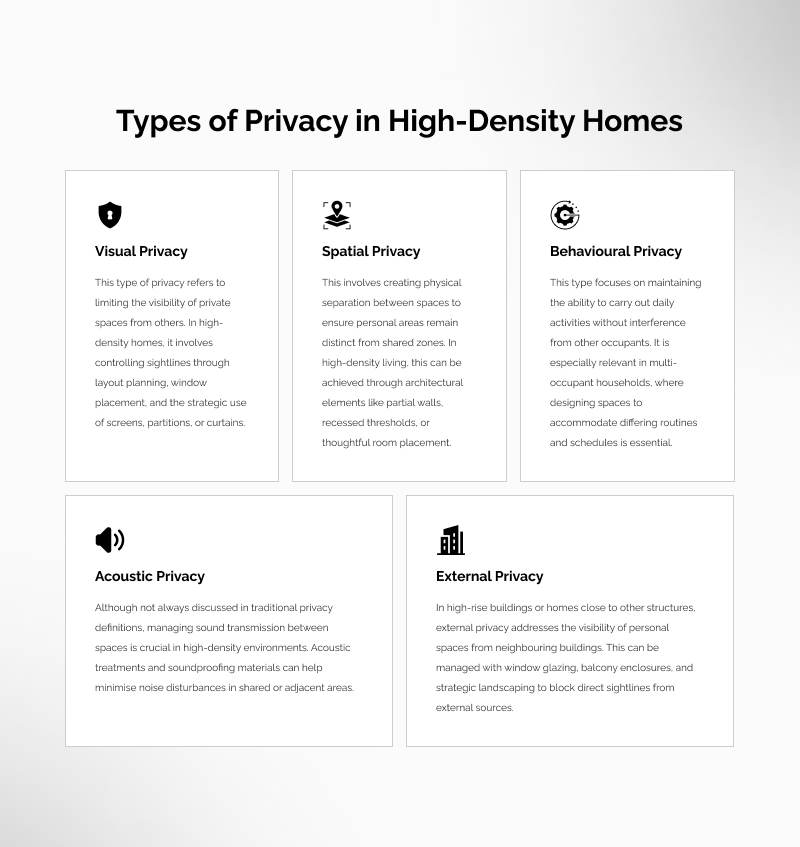
Visual Privacy as Control Over Exposure
Internal Sightlines Within the Home
Visual privacy within a home is influenced by what is visible at first glance and what remains concealed through spatial sequencing. Direct sightlines from entrances into living or private zones create a constant sense of exposure, even when no one else is present. Peripheral visibility, or what can be seen indirectly while moving through the space, also affects perceived privacy, particularly when reflective surfaces or open shelving amplify visual reach. Designing for effective privacy addresses both direct and peripheral sightlines, ensuring that visibility is intentional rather than accidental.
External Visibility From Surrounding Buildings
External sightlines from neighbouring units, corridors, and shared spaces further complicate efforts to maintain housing privacy in high-density settings. Window placement, glazing extent, and internal zoning all influence how much of a home is visible from the outside, particularly in developments where blocks are closely positioned. In these environments, privacy cannot be ensured by curtains or blinds alone. Interior layouts must account for these external conditions to ensure adequate visual privacy.
Spatial Privacy as the Relationship Between Spaces
Hierarchy Between Shared and Personal Zones
Spatial privacy in homes is established through a clear hierarchy, where communal areas and personal zones are intentionally differentiated. When all spaces are equally open and accessible, personal boundaries blur, forcing constant negotiation between occupants. A well-considered hierarchy allows shared areas to remain accessible while preserving the autonomy of private spaces. This is especially important in homes where privacy-focused interior design is essential for ensuring comfort.
Transitional Spaces as Functional Buffers
Transitional spaces such as corridors, vestibules, and recessed thresholds play a critical role in mediating privacy within dense homes. These areas act as functional buffers, creating moments of separation without fully enclosing the space. They allow residents to move between zones without immediately exposing them to adjacent areas. In high-density living, these “in-between” spaces often determine whether a home feels controlled or continuously exposed, ensuring that designing for privacy is effectively maintained throughout the home.
Behavioural Privacy Within Shared Households
Behavioural privacy refers to how multiple occupants coexist within the same home, particularly when schedules, routines, and activity types differ. In dual-income or multi-generational households, overlapping work, rest, and leisure patterns can create friction if spaces are not designed to support simultaneous use. Designing for privacy anticipates these overlaps, reducing the need for constant adjustments or compromises between occupants. This ensures a more harmonious living environment for all members.
Privacy as an Expression of Contemporary Luxury
Moving Beyond Visible Luxury
Traditional markers of luxury in interior design often emphasise visual statements, but in high-density living environments, luxury increasingly manifests through control, discretion, and ease of use. Privacy-led interiors prioritise functionality and experience rather than ostentatious displays, allowing spaces to serve their purpose without drawing attention to their design mechanisms. This quieter form of luxury emphasises proportion, alignment, and restraint over ornamentation, reflecting a sophisticated and timeless approach to interior design in Singapore.
Privacy as a Signal of Design Maturity
Homes that successfully integrate privacy demonstrate a deeper level of design maturity. They reflect long-term thinking, accommodating evolving routines and practical needs rather than focusing on short-term visual impact. Designing for privacy in this context is not an optional enhancement but is an essential design element. Thoughtfully designed spaces prioritise discretion during everyday use, allowing residents to move seamlessly between personal and shared spaces. These considerations, although subtle, shape how the home supports real routines over time, reinforcing privacy as a lived experience rather than just a visual feature.
Design Strategies That Support Privacy Without Compromising Refinement
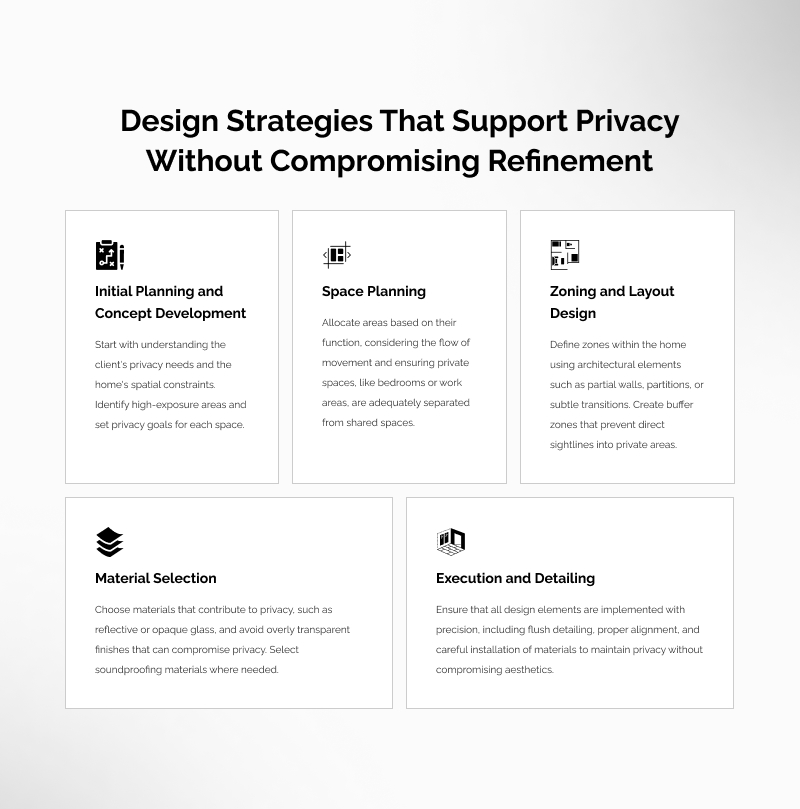
Layout-Led Privacy Through Spatial Judgement
Privacy within a home is often determined by how spaces are arranged and how movement between them is managed. Thoughtful layout planning helps regulate visibility, circulation, and spatial relationships so that residents can move through the home without unnecessary exposure. By carefully organising the sequence of spaces, designers can create a clearer transition between public and private areas while maintaining a cohesive overall layout.
Entry Sequences and Visual Control
Managing First Points of Exposure
The entrance of a home plays a critical role in establishing the initial privacy conditions. It determines how much of the interior is visible when someone enters the space. Direct exposure to living or private zones can create a persistent sense of vulnerability, even when the space is unoccupied. By thoughtfully managing the entry sequence, visual access to key areas can be limited, creating an environment designed to balance openness with privacy.
Layered Arrival Experiences
Layered arrival paths introduce gradual visual transitions, allowing the home to unfold rather than present itself all at once. These transitions reduce the immediate disclosure of the interior and create a more controlled spatial experience. For residential interior design projects, firms like Jialux Interior apply this technique through deliberate layout planning, ensuring privacy is established without sacrificing overall flow and elegance.
Reducing Cross-Visibility Across Key Spaces
Avoiding Direct Axial Alignments
When living spaces, bedrooms, or work areas are directly aligned along the same axis, visual overlap becomes inevitable, reducing privacy between different areas. Once these direct alignments are established, they are difficult to correct without structural changes. Thoughtful space planning prevents unnecessary exposure by adjusting circulation paths and spatial orientation early in the design process. This approach ensures privacy while preserving the home’s aesthetic and flow, which is especially important for HDB interior design projects in Singapore.
Architectural Elements That Support Discretion
Partial enclosures, offset walls, and integrated architectural features help to interrupt sightlines without fragmenting the space. When incorporated from the outset, these elements support privacy while preserving a cohesive interior language. This design philosophy favours subtle control and restraint over overt separation, preserving privacy without compromising refinement or elegance.
The Role of Professional Space Planning
Designing for privacy in high-density homes often requires measured trade-offs between openness, visual continuity, and separation. Effective space planning identifies which compromises will have the least long-term impact on daily life, rather than prioritising openness at the expense of personal boundaries. When these trade-offs are not addressed early in the process, privacy issues often surface after completion, leading to dissatisfaction that is difficult to resolve without structural adjustments. Jialux Interior’s emphasis on space planning and layout judgment ensures that privacy considerations are integrated from the very beginning, resolving potential issues structurally rather than cosmetically.
Zoning for Privacy Within Open, Shared Homes
In homes where multiple activities take place within a continuous layout, zoning becomes an important planning strategy. By organising different functions into clearly defined areas, designers can maintain openness while ensuring that each activity retains an appropriate level of separation. This approach allows shared spaces to remain visually connected while supporting everyday routines that require a degree of discretion.
Functional Territories Without Physical Separation
Open layouts often require a subtle differentiation between multiple functions within a single visual field. Designing for privacy is achieved when each function, work, rest, or social interaction has a clearly defined spatial identity, even without the need for physical walls. These distinctions allow occupants to engage in various activities without constant visual or behavioural interference.
Effective zoning within open-concept spaces is critical for ensuring privacy is respected, even in shared homes.
Design Signals That Establish Boundaries
Ceiling and Volume Transitions
Changes in ceiling height or treatments can signal shifts in spatial function without altering the floor plan. Vertical variation introduces a sense of enclosure or openness that aligns with the intended level of privacy in each zone. When consistently executed, these transitions enhance spatial hierarchy in designing for privacy and visual coherence. This technique is especially effective in condo interior design projects in Singapore, where space efficiency and privacy management are key priorities.
Lighting as a Zoning Mechanism
Lighting strategies contribute significantly to privacy by defining territories through intensity, focus, and distribution. Layered lighting allows different zones to operate independently, supporting simultaneous activities within shared spaces. This approach relies on coordination between design intent and technical execution. In projects like those handled by Jialux Interior, designing for privacy with lighting is a key tool for delineating spaces while maintaining a refined, cohesive look that supports both privacy and functionality.
Material, Detailing, and Craftsmanship as Privacy Infrastructure
Material Behaviour and Visual Discretion
The materials chosen for a space influence how light and visibility travel through it, directly affecting privacy. Highly reflective or transparent surfaces can unintentionally increase visual exposure in residential design if not carefully placed. Privacy-led material selection considers how finishes behave under real lighting conditions, rather than focusing solely on their appearance in isolation. At Jialux Interior, choosing materials with privacy in mind keeps the home visually controlled while still allowing light to fill the space in a balanced, aesthetically pleasing way.
Built-In Elements as Structural Privacy Support
Integrated Carpentry and Flush Detailing
Built-in elements that are integrated into the architectural framework provide more effective privacy than temporary add-ons. Flush detailing reduces visual clutter and prevents unintended sightlines created by protruding elements. This integration reflects a commitment to long-term functionality and privacy, rather than simply focusing on surface aesthetics. Such attention to detail is especially important in projects where optimising space and designing for privacy are vital to creating luxurious, functional homes.
Precision in Execution and Workmanship
Privacy strategies rely heavily on accurate installation, alignment, and finishing. Even small misalignments or gaps can undermine the intended outcome, affecting both discretion and the overall quality of the space. Designing for privacy ensures that privacy considerations are effectively translated from design to completion, resulting in spaces that are not only aesthetically refined but also functional and private.
Questions You Might Ask
-
How does Jialux Interior approach privacy differently from typical renovation firms?
Privacy is treated as a foundational design outcome rather than a secondary consideration addressed after layouts are finalised. From the earliest planning stages, spatial relationships, sightlines, and adjacencies are evaluated to anticipate where exposure may occur during everyday living. Layout, zoning, and detailing decisions are therefore aligned around discretion from the outset, reducing reliance on reactive solutions such as added screens or partitions after completion. This approach reflects a deeper emphasis on spatial judgement and long-term liveability rather than surface-level adjustments.
-
Can privacy be achieved without compromising openness or refinement?
Privacy does not require a home to feel enclosed or visually heavy when it is addressed through proportion, sequencing, and spatial hierarchy. Layered transitions, controlled sightlines, and subtle zoning allow different areas of the home to function independently while maintaining visual continuity. Instead of relying on full-height walls or overt separations, privacy is achieved through how spaces relate to one another, preserving openness and refinement without sacrificing discretion.
-
Does prioritising privacy affect renovation costs or timelines?
Designing for privacy typically depends more on planning clarity than on additional materials or features. When privacy considerations are resolved early, through layout logic, zoning strategy, and detailing intent, there is often less need for corrective work later in the renovation process. This early resolution can help minimise mid-project changes, reduce the likelihood of post-completion dissatisfaction, and support a smoother overall timeline rather than extending it.
-
Is designing for privacy only relevant for certain home types or layouts?
Privacy considerations apply across a wide range of Singapore homes, from HDB flats to condominiums and landed properties. Although the specific challenges vary with building proximity and layout constraints, the core principles of exposure control, spatial hierarchy, and behavioural separation remain applicable across all home types. Privacy is therefore not tied to a particular housing category, but to how the interior is planned in response to its surrounding context.
-
At what stage of the renovation process should privacy be addressed?
Privacy is most effectively addressed during the early design and space-planning stage, before layouts and structural decisions are finalised. At this point, spatial relationships can still be adjusted without high cost or disruption. Once construction is underway, privacy issues often become more difficult to resolve without compromises. Addressing privacy from the outset allows it to be integrated seamlessly into the overall design rather than treated as an afterthought.
Conclusion
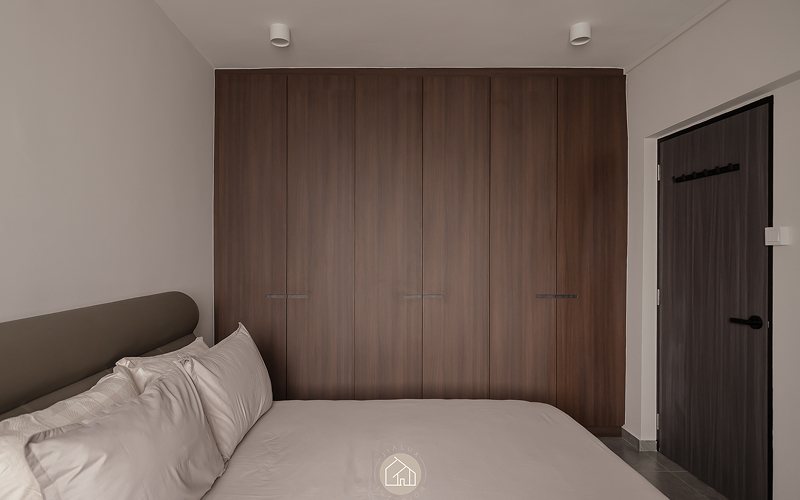
Beyond immediate visual appeal, designing for privacy enhances how homes are used over time, adapting to changes in routines, household composition, and work patterns without constant adjustments. Thoughtful planning allows spaces to adapt to changes in routines, household composition, and work patterns without constant adjustments. In Singapore’s high-density living environment, privacy has shifted from a secondary concern to a defining feature of daily home life, influencing how people move, live, and establish personal boundaries.
Effective privacy emerges from planning discipline, spatial judgement, and execution accuracy rather than relying on decorative measures. This requires making decisions early in the design process and applying them consistently to ensure long-term functionality. Homes that successfully integrate privacy demonstrate a deeper level of luxury, where design supports everyday living without drawing attention to itself.
Jialux Interior excels in delivering privacy-led interiors through thoughtful space planning, refined detailing, and reliable end-to-end execution, ensuring that privacy is addressed structurally rather than cosmetically. As residential density continues to increase, designing for privacy remains a core responsibility of considered interior design, shaping homes that remain functional long after renovations are complete.
For homeowners who view privacy as a long-term design consideration rather than a finishing touch, engaging in an early design discussion with Jialux Interior allows for a comprehensive evaluation of spatial relationships, exposure points, and daily routines. This ensures a stronger foundation for a home that supports discretion from the outset.